
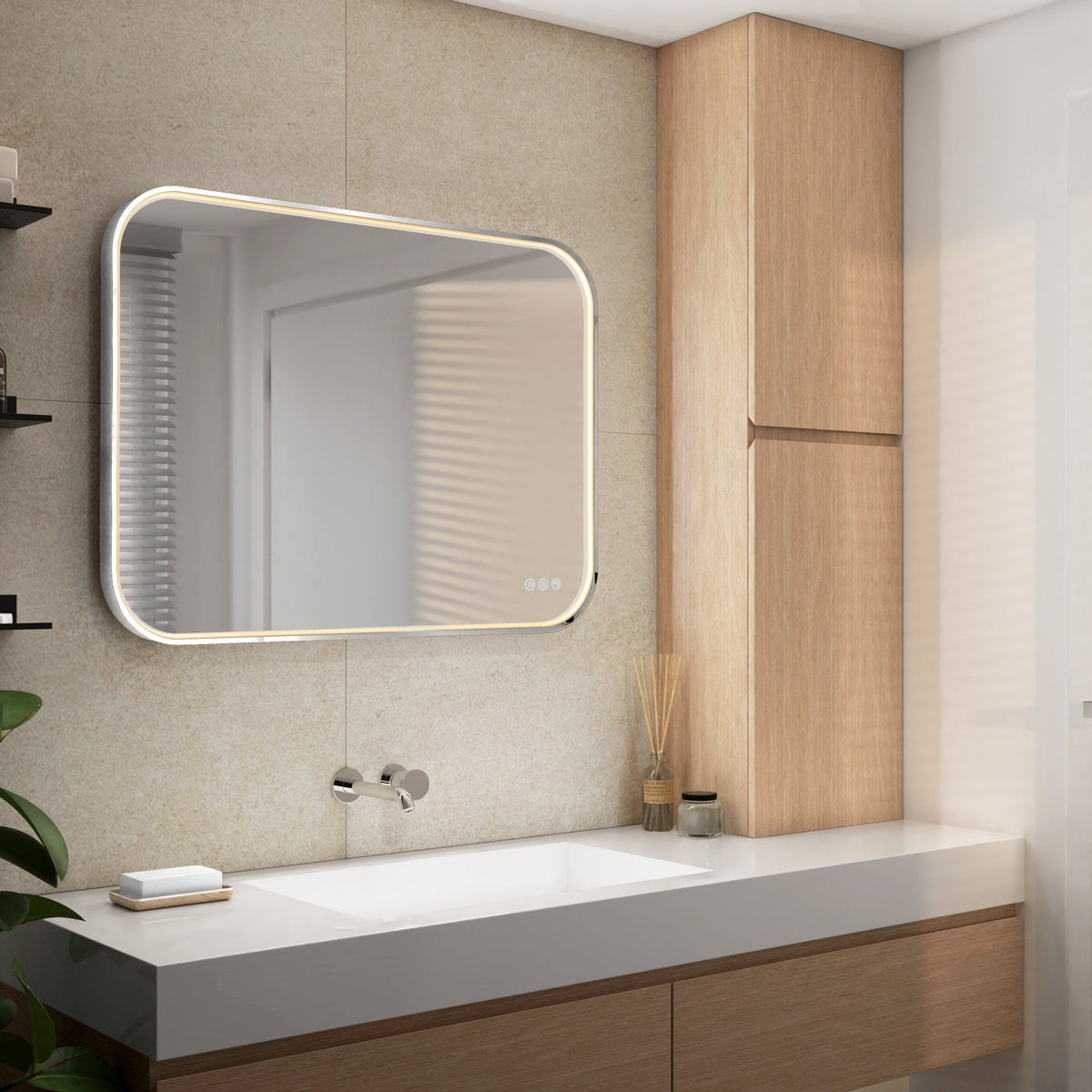
Bathroom lighting in 2026 hinges on three numbers: 1,500 to 3,000 lumens of vanity task light, a colour temperature in the 3000K to 3500K range, and a fixture that's roughly 75 percent the width of the mirror it sits above or beside. The shift designers committed to this year is layered light with switchable colour temperature, instead of one cool overhead can light doing all the work.
Renovation budgets tend to disappear into tile, stone, and cabinetry. The vanity light becomes the afterthought picked up on the way home from the showroom. The result is a beautiful room that fights you at the mirror every morning. Lumens are simply the measurement of visible light a fixture produces, and a bathroom needs a generous, well-placed dose of them.
What Are the Top Bathroom Lighting Trends in 2026?
Three movements are reshaping how bathrooms get lit this year. Switchable colour temperature leads the pack. A fixture with 3 or 5 CCT (Correlated Colour Temperature) settings replaces what used to be a bulb-swap routine. One fixture covers cool morning light, neutral working light, and warm evening light from the same wall.
Warm metals such as brass, aged nickel, and matte black have moved into the default slot once held by polished chrome, especially in renovations leaning on warm neutral palettes. Shape has changed too: a single dome, a ring sconce, or a slim linear bar has displaced the four-light Hollywood chrome bar that defined builder-grade bathrooms for years.
These aren’t aesthetic flourishes. Tunable CCT lines up with the body’s circadian rhythm, where cooler light energizes a morning routine and warmer light helps the body wind down. Warm-finish metals stay looking sharp longer than chrome, which fingerprints and dates quickly. Sculptural shapes pack visual interest into the powder rooms and half baths where wall space runs out fast, and Artika’s vanity light collection gathers all three movements into one place.
Vanity Lighting Is the Upgrade That Matters Most
The light at the mirror does more for how you actually look than any other fixture in the home. A weak one creates shadows on the eyes, nose, and chin. A strong one like 1,500 to 3,000 lumens delivered through a proper diffuser renders skin tone accurately and clears those shadows out.
The designer benchmark: width the fixture to about 75 percent of the mirror, and mount it 65 to 70 inches from the floor. For households that want tunable colour, the Crystal Cube 5 CCT vanity light is a current go-to at 1,300 lumens across five shades of white. The three crystal-style diffusers in a matte black frame throw light at angles rather than glaring directly out at the mirror.
Side Lighting vs Overhead Vanity Lighting
The gold standard is a pair of fixtures flanking the mirror at face height, roughly 65 to 70 inches above the floor. Side light cancels the shadow an overhead fixture casts under the brows, nose, and chin. Every well-lit hotel bathroom is built around this principle.
Overhead wins on convenience: the electrical box is already in the ceiling, so most renovations default to it. It works as long as you accept the compromise: more facial shadow and a heavier reliance on a wide bar (24 inches for a 32-inch mirror; 36 to 40 inches for a 48-inch mirror) to push light across the vanity.
The pragmatic answer most designers reach for in full bathrooms is to combine both: sconces at the sides for face light, plus a small ambient ceiling fixture for room brightness. In a half bath or powder room where no one’s getting ready in the mirror, overhead alone is plenty.
How to Size a Vanity Light to Your Mirror
Start with the 75 percent rule. Measure the mirror, then look for a fixture that’s about three-quarters as wide. A 36-inch mirror takes a 27-inch fixture; a 48-inch mirror takes a 36-inch fixture; a 60-inch mirror takes a 45-inch fixture.
For a double vanity with two mirrors, skip the single long bar across both. Two separate fixtures, each centred above its own mirror, distribute light evenly to both sinks. A single long bar creates a hot zone in the middle and shadowy ends.
Ambient lighting for the room itself should land near 70 to 80 lumens per square foot. A standard 5-by-8-foot bath needs roughly 3,000 lumens of ambient light, separate from the vanity. A 1,500-lumen flush mount covers about half of that on its own, and a dimmer carries the rest through the day.
Bathroom Lighting Mistakes to Avoid
The single most common mistake is depending on one ceiling fixture for the whole room. The result is a bathroom that’s bright at the doorway, dim at the mirror, and shadowed exactly where it shouldn’t be.
The second is putting a fixture rated for dry locations into a bathroom. Any fixture inside the room should be at minimum damp-rated, with a CSA or cUL label on the box. Inside the shower zone or directly above a tub it needs to be wet-rated. Damp means no direct water contact; wet means the fixture can take direct exposure.
The third is reaching for 5000K bulbs because the label says “daylight” or “natural white.” That colour reads cold in a bathroom, and skin looks grey, makeup reads off, the whole room feels institutional. Stay in the 3000K to 3500K range, or pick a fixture with tunable CCT so you can move between cool and warm as the day shifts.
The full prescription for a modern bathroom: vanity fixture sized at 75 percent of mirror width and mounted at face height, ambient ceiling fixture delivering 70 to 80 lumens per square foot, both tuned to 3000K to 3500K and on a dimmer. Artika’s bathroom collection is built around those specs.
Frequently Asked Questions
How many lumens does a bathroom need?
Most full bathrooms need 70 to 80 lumens per square foot of ambient light, plus 1,500 to 3,000 lumens of vanity task light at the mirror. A standard 5-by-8-foot bath comes out to about 3,000 ambient lumens plus the vanity load. A dimmer on the same fixture lets the same room handle a bright grooming hour and a dim midnight visit. Powder rooms run lower, with around 4,000 total lumens across all sources for a 25-square-foot space.
What is the best colour temperature for bathroom lighting?
The 3000K to 3500K range works best for bathrooms. It’s warm enough to flatter skin, cool enough to see makeup and skin tone clearly. Anything 5000K or higher reads clinical and washes the face out; anything below 2700K leans yellow and makes grooming harder. A tunable CCT model with 3 or 5 settings gives you both ranges from one fixture, and that flexibility has become standard on better-quality vanity lights.
How wide should a vanity light be?
Roughly 75 percent of the mirror’s width. So a 36-inch mirror calls for a 27-inch fixture, and a 48-inch mirror takes a 36-inch fixture. With a double vanity and two separate mirrors, two individual fixtures (one centred over each sink) outperform a long single bar spanning the entire countertop. The light spreads evenly across both sinks instead of pooling in the middle.
Do bathroom light fixtures need to be damp-rated?
Yes. Any fixture installed inside a bathroom should carry at least a damp-location rating, and fixtures inside the shower or directly above the tub need to be fully wet-rated. Damp means no direct water contact; wet means direct exposure is fine. The CSA or cUL marking on the packaging confirms the rating, and most modern LED bathroom fixtures meet damp-rated standards out of the box.